All Lessons
Every episode comes with a learning objective, key concepts, vocabulary, standards alignment, and a quiz. Search by topic, vocabulary word, or standard code like 2.MD.C.7.
202 lessons
How Do Dogs Talk Without Words? Sniffs, Tails & Secret Signals
Students will learn that dogs "talk" with their bodies and their super-powered noses — a wagging tail, a play bow, pinned ears, and a sniff all carry meaning — and that reading a dog's body language helps us understand what a dog is feeling (NGSS 1-LS1-1 / 4-LS1-2 — animals use senses and signals to gather and respond to information).
What Does a Pet Really Need? Pet Responsibilities for Kids
Students will learn that a pet is a living friend who depends on you EVERY day — food, water, exercise, vet visits, training, and love — and that being a great pet owner is a promise for the pet's whole life, not just when it's fun (NCSS/state social-studies: responsibility, caring for others, citizenship at home).
Why Are There So Many Dog Breeds? From Wolves to Wiener Dogs
Students will learn that every dog — from a tiny chihuahua to a giant Great Dane — is the SAME animal, descended from wolves, and that humans created hundreds of breeds by choosing which dogs became parents so helpful traits were passed down and strengthened (3-LS3-1/3-LS3-2 — inherited traits and variation, extended to artificial selection).
Contact or at a Distance? Sorting Forces for Kids
Students will learn to sort forces into two groups — **contact forces** that need touching (push, pull, friction) and **distance forces** that act without touching (gravity, magnetism, static electricity) — by playing a sorting game that tags each example. (TEKS 3.7A — demonstrate and describe forces; NGSS 3-PS2-1/3-PS2-3 — forces acting without contact.)
Which Cup Keeps Ice Cold the Longest? Insulation Test
Students will learn that heat moves from warmer things into cooler things — and that **insulation** slows that heat down — by running a fair test: identical ice cubes in a metal cup, a paper cup, and a foam cup, measuring which melts last. (TEKS 3.6D — materials as engineering choices; TEKS 3.8A thermal energy; NGSS 3-5-ETS1-3 fair tests.)
Which Materials Keep Water Out? A Waterproof Design Challenge
Students will learn that **waterproof** materials don't let water soak through — they repel it so it beads and rolls off — while **absorbent** materials soak it up like a sponge. A drip-test on paper, cloth, and plastic shows which roof material keeps a tiny paper house dry. (TEKS 3.6D — pick materials by properties to solve problems; NGSS 2-PS1-2 — test properties for a purpose; NGSS 3-5-ETS1-2.)
Which Material Builds the Strongest Tower?
Students will learn that a material's **strength** depends on its properties — and that SHAPE changes strength too (flat paper is weak, folded/rolled paper is strong) — by running a fair test: same-size pieces of paper, foil, and cardboard, stacking books on each mini-tower until it buckles. (TEKS 3.6D — choose materials by properties to solve problems; NGSS 3-5-ETS1-2 test solutions.)
Can Matter Change State and Change Back?
Students will learn that some changes caused by heating or cooling are **reversible** — the material can change back (ice↔water, melted chocolate → solid chocolate, water vapor → liquid) — while others are **irreversible** and make something new (toasting bread, cooking an egg). (TEKS 3.6C; NGSS 2-PS1-4.)
What Happens to Matter When It Is Heated or Cooled?
Students will learn that heating adds energy and cooling takes energy away — and that at certain temperatures matter changes state: solids melt to liquids, liquids freeze to solids, liquids evaporate to gas, and gas condenses back to liquid. (TEKS 3.6C — predict, observe, and record changes in matter caused by heating or cooling; NGSS 2-PS1-4.)
Is Air Matter Even Though You Cannot See It?
Students will learn that air is real matter — it takes up space and has mass — proven with two kid-safe tests: an underwater cup that keeps a paper towel dry (air takes up space) and a balance of balloons that tips when one is inflated (air has mass). (TEKS 3.6B — matter has observable properties; NGSS 5-PS1-1.)
How Can Temperature Be Measured Fairly?
Students will learn that hands are unreliable temperature judges — the same lukewarm water feels hot to a cold hand and cold to a warm hand — so we measure temperature fairly with a **thermometer**, the same tool giving the same answer every time. (TEKS 3.6A — measure/test/record properties of matter including temperature; NGSS 3-5-ETS1-3 — fair tests with controlled variables.)
How Do Engineers Solve Problems? The Design Process for Kids
Students will learn the engineering design process — **Ask → Imagine → Plan → Build → Test → Improve** — by watching a team solve a real problem: getting a toy car across a gap. The bridge fails the first test, and that's the POINT — failure tells the engineers what to fix. (NGSS 3-5-ETS1-1/2/3 — define the problem, compare solutions, fair tests; TEKS science practices.)
Why Do Families Share Traits? Inherited Traits for Kids
Students will learn that **inherited traits** are features passed from parents to offspring — like eye color, fur pattern, and ear shape — while **learned traits** are things you pick up, like riding a bike or knowing a song. Siblings share some traits but differ because each kid inherits a different mix. (NGSS 3-LS3-1 inheritance + variation; 3-LS3-2 environment can influence traits.)
What Really Happens Inside a Volcano? Eruptions Explained for Kids
Students will learn what's actually inside a volcano — melted rock called **magma** stored in a chamber deep below — and that eruptions happen when gas pressure inside that magma pushes it up through a vent, where it becomes **lava**. Some eruptions ooze gently; some blast. (TEKS 3.10C — volcanic eruptions as rapid changes to Earth's surface; NGSS 4-ESS2-2 / 4-ESS3-2.)
Why Do Gases Fill Their Containers?
Students will learn that a gas has no shape of its own — it spreads out to fill every part of whatever container it is in, because its tiny particles zoom around and bounce into every corner (TEKS 3.6B — classify matter as solids, liquids, and gases by shape and volume behavior).
What Is Air Resistance? Parachute Challenge
Students will explain that air resistance (drag) is a force that pushes back against a falling object, that more surface area means more air resistance, and that this is why a parachute makes a falling object slow down dramatically (TEKS 3.6C).
How Does Energy Move Through a Food Chain? Ecosystems for Kids
Students will trace how energy flows from the Sun through a food chain (producer → primary consumer → secondary consumer → decomposer), and explain that only a small fraction of energy passes to each next level (TEKS 3.9A, 3.9B).
Why Do Animals Migrate or Hibernate? Seasonal Survival for Kids
Kids will be able to name and tell apart three real animal strategies for surviving a hard winter — migrating (traveling to a better place), hibernating (a deep, body-slowing sleep), and adapting in place (staying active but changing behavior or body) — with a real animal example for each (TEKS 3.12A).
How Does Rock Turn Into Soil? Soil Formation for Kids
Students will explain how rocks physically and chemically break down over time, and how decomposing plants and animals add organic matter, together forming soil (TEKS 3.10B).
Why Can the Weather Be Different at the Same Time? Compare Two Cities
Kids will understand that weather is LOCAL — it depends on where a place is (how close to the ocean, how high up, how much moisture is nearby) — so two cities in the very same state, at the very same moment, can have completely different weather. TEKS 3.10A (weather patterns, measuring weather over time) / NGSS 3-ESS2-2 (describe climates in different regions).
Can Mixing Materials Make Them Stronger? A Materials Engineering Challenge
Students will understand that mixing two materials (sand and clay) can produce a new mixture with physical properties — like strength — that neither material has on its own, and that engineers test different ratios through fair, controlled comparisons to find the best mix.
How Do Simple Machines Make Work Easier? Six Machines for Kids
Students will name the six simple machines (lever, wheel and axle, pulley, inclined plane, wedge, screw) and explain how each one changes the force needed or the direction of a push or pull, without changing the total amount of work done.
How Is Sound a Form of Energy? Vibrations for Kids
Students will learn that sound is a form of energy made by vibrations — fast back-and-forth wiggles in matter — and that sound can push on real things (sprinkles jumping on a drum, water rippling from a tuning fork) because moving vibrations carry energy from the source to the receiver (TEKS 3.8A).
Where Does Thermal Energy Hide? Heat in Everyday Life
Students will learn that thermal energy is the energy of jiggling, zooming particles — that it always flows from hotter things to cooler things — and that some materials (like metal) move that energy along much faster than others (like wood or plastic), which is why a metal spoon in hot cocoa gets scorching fast while a wooden spoon stays cool enough to hold.
What Counts as Light Energy? Everyday Examples for Kids
Students will be able to tell light SOURCES (things that make their own light, like the Sun or a firefly) apart from REFLECTORS (things that only bounce light that already exists, like a mirror or the Moon), and explain that the Moon shines by reflecting sunlight rather than glowing on its own.
Does Faster Mean More Energy? A Rolling-Ball Investigation
Students will learn that a moving object's energy of motion (kinetic energy) grows with the SQUARE of its speed — so doubling an object's speed gives it roughly four times the energy of motion, not just twice as much — and will see this demonstrated by comparing the size of a crater punched into clay by the same ball rolled at two different speeds.
What Are the Four Forms of Energy Around Us?
Students will identify and tell apart the four forms of energy observed in everyday life -- mechanical, light, thermal, and sound -- and recognize that a single everyday event (like a campfire) can produce several forms of energy at the same time.
How Do Forces Affect Motion? Pushes and Pulls for Kids
Students will identify a force as a push or a pull, and explain how forces (including the non-contact forces gravity and magnetism) can start, stop, speed up, slow down, or change the direction of a moving object. (TEKS 3.7A/3.7B)
4 Types of Sentences: Tell, Ask, Command, Wow!
Students will learn the four types of sentences — declarative, interrogative, imperative, and exclamatory — and how punctuation marks tell you which type each sentence is.
Common vs Proper Nouns: Name That Thing!
Students will learn the difference between common nouns (general names) and proper nouns (specific, capitalized names).
What Are Factors and Multiples?
Kids learn a factor is a number that divides another number exactly (factors of 12: 1,2,3,4,6,12), and a multiple is what you get when you multiply a number by a whole number (multiples of 4: 4,8,12,16…).
Arrays: Multiplication You Can SEE!
Students will learn to use arrays as a visual model for multiplication, understanding rows and columns and discovering the commutative property by turning arrays sideways.
Adding Big Numbers: Regrouping Made Easy
Students will learn how to add numbers within 1,000 using regrouping (carrying) — lining up place values and trading 10 ones for 1 ten.
What Is Energy? Light, Heat, and Sound!
Students will learn that energy is what makes things happen, and that light, heat, and sound are three forms of energy we can observe every day.
What Is a Life Cycle? From Egg to Grown-Up
Students will learn that a life cycle is the repeating pattern of birth, growth, and reproduction in a living thing's life, using butterfly and frog examples.
Food Chains: Producers, Consumers, and Decomposers
Kids learn a food chain shows how energy moves: the Sun → producers (plants) → consumers (animals) → decomposers (recyclers).
Solids, Liquids, and Gases: What's Matter Made Of?
Students will identify the three states of matter — solids, liquids, and gases — by their observable properties, and explain how adding or removing heat changes one state into another.
How Do Earbuds Make Sound?
Students will learn how earbuds turn electricity into sound you can hear.
What Is Fog?
Students will learn what fog is and how tiny water droplets make the air hard to see through.
How Do Telephones Carry Voice?
Students will learn how telephones turn sound into signals and send voices over wires or through the air.
Why Is the Sky Red at Sunset?
Students will learn why the sky changes colors at sunset and how sunlight scatters through the atmosphere.
How Do Springs Work?
Students will learn how springs store and release energy by stretching and compressing.
What Is Force and Motion?
Students will learn that a force is a push or a pull, that forces cause objects to move or change direction, and that motion is when an object changes position.
What Is Dew?
Students will learn what dew is, how it forms, and why it appears in the morning.
What Is Perimeter? Measuring Around Shapes
Students will learn what perimeter is and how to measure it by adding up the sides of a shape.
What Are Context Clues? Figure Out Any Word
Students will use the words around an unknown word — context clues — to work out what that word means, without a dictionary.
Why Am I Nervous on the First Day of School?
Students will explain what nervous feelings are, why the brain makes them, and use two simple, evidence-backed ways to calm their body down.
How Do You Read a Map?
Students will use a map key, a compass rose, and a scale bar to find places and describe where they are.
How Do Scientists Figure Things Out?
Students will describe how scientists test an idea: ask a question, make a hypothesis, run a fair test, and let the evidence decide.
What Is the Main Idea? Find It Fast
Students will find the main idea of a paragraph and tell it apart from the supporting details that hold it up.
What Is Multiplication? Equal Groups Made Easy
Students will understand multiplication as counting equal groups, and use arrays and the times sign to find a total fast.
Why Is Math Boring
Students will learn why some people find math boring, how the brain learns math best, and three ways to make math fun — games, puzzles, and finding math in real life.
Why Can't I Focus? Tips for Kids
Students will learn what focus is, why young brains get distracted, and three simple strategies to improve attention — taking breaks, removing distractions, and practicing one thing at a time.
How Do Fossils Form?
Students will learn how fossils form — that when plants or animals die and get buried under layers of sediment, over millions of years the remains turn to stone and become fossils.
Place Value to Thousands
Students will learn that each digit in a number has a place value — ones, tens, hundreds, and thousands — and that the position of a digit determines its value.
Rounding Numbers: Tens and Hundreds
Students will learn how to round numbers to the nearest ten and nearest hundred using a simple rule: look at the digit next door, and decide whether to round up or stay the same.
What Will Jobs Be Like in the Future?
Students will learn how jobs are changing with technology, explore future careers like robot designer and space farmer, and understand that new inventions create new kinds of work.
How Do Earthquakes Happen?
Students will learn how earthquakes happen — that Earth's crust is made of moving puzzle pieces called tectonic plates, and when they push, pull, or slip past each other, energy is released as shaking.
What Are Suffixes? Word Endings Explained
Students will learn what suffixes are, how adding them to the end of a word changes its meaning, and common suffixes like -ful, -less, -er, -ly, and -ness.
Why Is the Ocean Salty?
Why Do Clouds Look White?
Students will learn why clouds appear white and sometimes turn gray or dark.
What Is a Rhyme?
Students will learn what rhymes are, how to identify them, and why poets and songwriters use them.
What Is Sleet?
Students will learn what sleet is, how it forms, and how it differs from rain, snow, and hail.
How Do Raindrops Form?
Students will learn how tiny water droplets in clouds join together to become raindrops that fall to the ground.
How Does Electricity Light a Bulb?
Students will learn how electricity flows through a light bulb and makes it glow.
How Do Roller Coasters Loop?
Students will learn the physics of how roller coasters stay on the track during a loop using speed and forces.
Why Do We Have a Belly Button?
Students will learn what a belly button is and how it connects to how we grew before birth.
How Does a Bicycle Stay Up?
Students will learn the basic physics of how a moving bicycle stays upright without falling over.
What Is Alliteration?
Students will learn what alliteration is and how repeating beginning sounds makes phrases fun and memorable.
Why Do We Have Hair?
Students will learn why humans and animals have hair and what jobs hair does for our bodies.
How Do Airplanes Fly?
Students will learn the basics of how airplanes fly using lift, thrust, drag, and weight.
Why Is Ice So Slippery?
Students will learn why ice is slippery and the thin water layer that forms on its surface.
Why Do Ships Float?
Students will learn about buoyancy and why huge ships can float while tiny coins sink.
Why Does It Snow?
Students will learn how snow forms in clouds and why it falls as flakes instead of rain.
Why Do Things Fall Down?
Students will learn about gravity — the invisible force that pulls everything toward Earth.
Why Do We Itch?
Students will learn what causes itching and why our body makes us want to scratch.
Why Do We Have Fingerprints?
Students will learn what fingerprints are, why we have them, and why they're unique.
Foil Boat Challenge!
The Biggest Animals on Earth!
How Do Humans Change Earth?
Understand that humans change Earth in both helpful AND harmful ways Identify major ways humans impact the planet: pollution, deforestation, habitat loss, and climate change Know the three types of pollution: air, water, and land pollution Understand that cutting down too many trees affects animals, air quality, and climate Learn that Earth is getting warmer because of pollution from burning fossil fuels (simplified climate change) Connect solutions to previous lessons: 3 Rs, renewable energy, conservation Feel EMPOWERED and HOPEFUL about making positive changes—not scared or overwhelmed Identify specific actions they can take to help protect the planet
The 9 Times Table Finger Trick!
Where Does Rain Come From? The Water Cycle!
What Is Division? Sharing Fairly
Students will learn what division is and how it helps us share things equally.
How Do Octopuses Change Shape?
Students will learn how octopuses can squeeze through tiny spaces and change their body shape.
Why Do Peacocks Have Such Big Feathers?
Students will learn why male peacocks have enormous colorful tail feathers and how they use them.
What Are Palindromes?
Students will learn what palindromes are and how to identify words and phrases that read the same forwards and backwards.
What Are Contractions?
Students will learn what contractions are, how they're formed, and how to use the apostrophe correctly.
How Do Fireflies Glow?
Students will learn how fireflies produce light through a chemical reaction called bioluminescence.
Why Does It Hail?
Students will learn how hail forms inside thunderstorm clouds and why ice balls fall from the sky.
Why Do Countries Have Flags?
Kids learn a flag is a symbol that stands for a group or country, and that its colors and pictures each mean something.
Why Does Frost Form on Windows?
Students will learn how frost forms on cold windows and why water turns into ice crystals.
Why Is the Sky Blue?
Students will learn why the sky looks blue and how sunlight scattering creates colors in the sky.
How Do Hurricanes Form?
Students will learn how hurricanes form over warm ocean water and what makes them spin.
Why Does Ice Melt?
Students will learn why ice melts and how temperature changes matter from solid to liquid.
Why Do We See Rainbows?
Students will learn how rainbows form when sunlight passes through raindrops.
Why Do Bubbles Pop?
Students will learn why soap bubbles pop and what makes bubble skin so fragile.
What Makes Thunder and Lightning?
Students will learn how thunder and lightning form inside storm clouds.
How Do Mirrors Work?
Students will learn how mirrors create reflections using light bouncing off smooth surfaces.
Why Are Sharks So Amazing?
Students will learn what makes sharks special, including their senses, teeth, and role in the ocean.
What Are Freckles and Why Do We Have Them?
Students will learn what freckles are, what causes them, and why some people have them.
How Do Thermometers Work?
Students will learn how thermometers measure temperature using materials that expand and shrink.
Why Do Your Fingers Wrinkle in Water?
Students will learn why fingers and toes wrinkle after being in water for a while.
Why Do We Get Hungry?
Students will learn why we feel hungry and how the body signals that it needs food.
How Does Your Immune System Fight Germs?
Students will learn how the immune system fights germs and keeps the body healthy.
Why Do We Snore?
Students will learn why some people snore and what happens in the throat during sleep.
Why Do We Get Nosebleeds?
Students will learn why noses sometimes bleed, how to handle it safely, and that it's usually not serious.
How Do Chameleons Change Color?
Why Do We Need Math?
Students will learn why math is useful in everyday life and how it helps us solve real problems.
Fractions with Pizza!
Why Do We Get Dizzy?
Students will learn why spinning makes us dizzy and how the inner ear helps us balance.
Why Do We Have Boogers?
How Does Your Brain Learn New Things?
Students will learn how the brain builds connections called synapses when practicing new skills.
Why Do Some People Faint at the Sight of Blood?
Students will learn why some people faint when they see blood and how the body's alarm system causes it.
Why Do Our Teeth Fall Out?
Students will learn why baby teeth fall out and how adult teeth grow in.
Why Do We Get Brain Freeze?
How Does Soccer Work? Football Rules for Kids
Students will learn the basic rules of soccer (football) and how the game is played around the world.
Why Do We Have Time Zones?
Students will learn why the Earth has time zones and how rotation creates different times around the world.
Why Do We Get Goosebumps?
Students will learn why our bodies get goosebumps and what causes this funny reaction.
Why Do We Dream?
Students will learn what dreams are, why we think they happen, and what our brains do while we sleep.
Why Do Cats Always Land on Their Feet?
Why Do We Blink?
Students will learn why we blink and how blinking keeps our eyes healthy and comfortable.
Why Do Bouncy Balls Bounce?
How Do Balloons Stick to Walls?
Students will learn about static electricity and why rubbed balloons can stick to walls.
What Are Homophones?
Students will learn what homophones are and how words that sound the same can mean different things.
How Do Electric Eels Shock?
How Do Birds Fly?
How Do Bats See in the Dark?
Why Does the Wind Blow?
Why Do We Have Seasons?
Students will learn why Earth has seasons and how the tilt of the Earth causes them.
Why Do We Cough?
Students will learn why we cough and how coughing helps protect our lungs.
Why Do We Breathe?
Students will learn why breathing is important and how our lungs use oxygen to help our bodies.
Why Do We Have Taste Buds?
Students will learn what taste buds are, how they detect flavors, and why they help us stay safe.
Why Do We Get Blisters?
Students will learn what blisters are and how they protect skin that has been rubbed too much.
What Are Clouds Made Of?
Why Does Spicy Food Feel Hot?
Students will learn why spicy food feels hot in your mouth and the chemical that causes the burn.
Why Do We Have Earwax?
Why Do We Cry?
Students will learn why we cry and the three different types of tears our body makes.
Why Do We Burp?
Students will learn what causes burps and how gas gets trapped in the stomach.
Why Do We Sneeze?
Why Do We Fart?
Why Do We Yawn?
Kids learn a yawn is a big deep breath, that scientists think it cools the brain / boosts alertness, and that yawns are contagious.
Why Do We Sweat?
Why Do We Get Hiccups?
Kids learn that a hiccup is a sudden twitch of the diaphragm (the breathing muscle), and the "HIC!" is the vocal cords snapping shut.
Why Do Spiders Make Webs?
Who Really Invented Marshmallows (and S'mores)?
What Poop and Urine Color Tells You
Students will learn about what poop and urine color tells you.
What Happens If You Swallow Gum
Students will learn about what happens if you swallow gum.
What Are Synonyms and Antonyms?
Kids learn a synonym means the SAME and an antonym means the OPPOSITE, and can spot pairs of each.
What Are Idioms and Can It Be Fun
Students will learn about what idioms are and how they can be fun.
Telling Time Like a Pro
Symmetry Is Everywhere!
Kids learn symmetry means both halves match along a line of symmetry, and can spot it in shapes, letters, and nature.
Why Do We Need Money?
How Are Coins Made?
Similes and Metaphors Make Writing Funny
Students will learn about similes and metaphors.
Why Is Slime a Liquid AND a Solid?
Why Did the Dinosaurs REALLY Disappear?
Why Dogs & Cats Can't Eat Chocolate
Who Invented the Toothbrush? (and Donuts!)
Who REALLY Invented Ice Cream?
Where Does Your Trash REALLY Go?
Where Does Poop Come From?
What Is Sound?
What Is Electricity?
What If Dinosaurs Never Went Extinct?
The Fastest Animals on Earth!
The 8 Planets of Our Solar System
Amazing Ocean Animals
How Do Tornadoes Form?
How Do Magnets Actually Work?
Good Germs vs Bad Germs!
What Would Happen If You Fell Into a Black Hole?
Could Humans Ever Really Fly?
Can You Really Fry an Egg on a Hot Sidewalk?
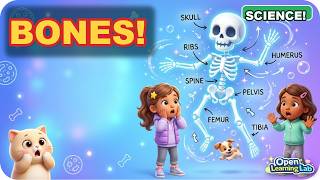
Your Bones & Skeleton
Are Cats REALLY Scared of Cucumbers?
Onomatopoeia: Words That Make Sounds!
Kids learn onomatopoeia = words that sound like the noise they name (buzz, splash, boom), and can spot and shout their own.
Multiplication Magic: 2-Digit Times 1-Digit
Meet Argentinosaurus: The Biggest Dinosaur?
Fractions Are Easy as Pie
Adding Within 20: Number Bonds Adventure
Why Does My Tummy Growl?
Kids learn the tummy rumble ("borborygmi") is the sound of air and food being squeezed through the stomach and intestines, and it's louder when empty.
Why Do Leaves Change Color?
What's Inside a Cell? The Tiny Building Blocks of Life
Spanish Animal Words: Say Hello in Spanish
How Do Bees Make Honey?
Meet the Gila Monster: Nature's Coolest Lizard
2D and 3D Shapes!
Kids learn 2D shapes are flat and 3D shapes are solid, and that 3D shapes have faces, edges, and vertices.
Why Does Water Form Outside a Cold Glass? Condensation for Kids
Students will learn that the "sweat" on a cold glass is NOT a leak — invisible water vapor in the air touches the cold surface, loses energy, and turns back into liquid droplets — condensation — and that the same process makes dew on grass, fog on a bathroom mirror, and the droplets inside clouds (TEKS 3.6B — water changes state between liquid and gas).
Why Do Same-Size Objects Sink Differently? Material Properties
Students will learn that sink-or-float is a property of the MATERIAL, not the size: same-size objects behave differently because of how much stuff is packed into that space — density — and objects denser than water sink while objects less dense float (TEKS 3.6A — the ability to sink or float as a physical property of matter).
Which Materials Are Magnetic? Test Before You Guess
Students will learn that magnetism is a testable property of materials — magnets pull on iron, nickel, and cobalt but NOT on aluminum, copper, plastic, wood, or rubber — and that guessing by "it's shiny metal" fails, so scientists predict and then TEST each material (TEKS 3.6A — magnetism as a physical property of matter).
Where Does a Puddle Go? Evaporation Investigation
Students will learn that a puddle doesn't vanish — its water evaporates: liquid water gains energy from warmth (the sun) and turns into invisible water vapor that rises into the air — and that the same water later condenses back into clouds and rain as part of the water cycle (TEKS 3.6B — matter changes state between liquid and gas).
How Do Seatbelts Keep You Safe?
Students will learn that a seatbelt is a force-spreading machine: it holds you in the seat so your body slows down WITH the car instead of flying forward, and it spreads that push across the strongest parts of your body — your shoulder bones and hips — instead of a soft tummy (TEKS 3.7A — forces change motion; safety-engineering framing).
How Do Scientists Measure Mass? Balance Scale Challenge
Students will learn that mass is the amount of matter — "stuff" — inside an object, that a balance scale measures mass by comparing two objects until the beam is level, and that size does not predict mass: a big puffy object can lose to a small dense one (TEKS 3.6A — measure, test, and record physical properties of matter, including mass).
Watch these lessons come alive on YouTube!
Subscribe to get new video lessons every week — taught by Ava & Hannah.
Subscribe Now